
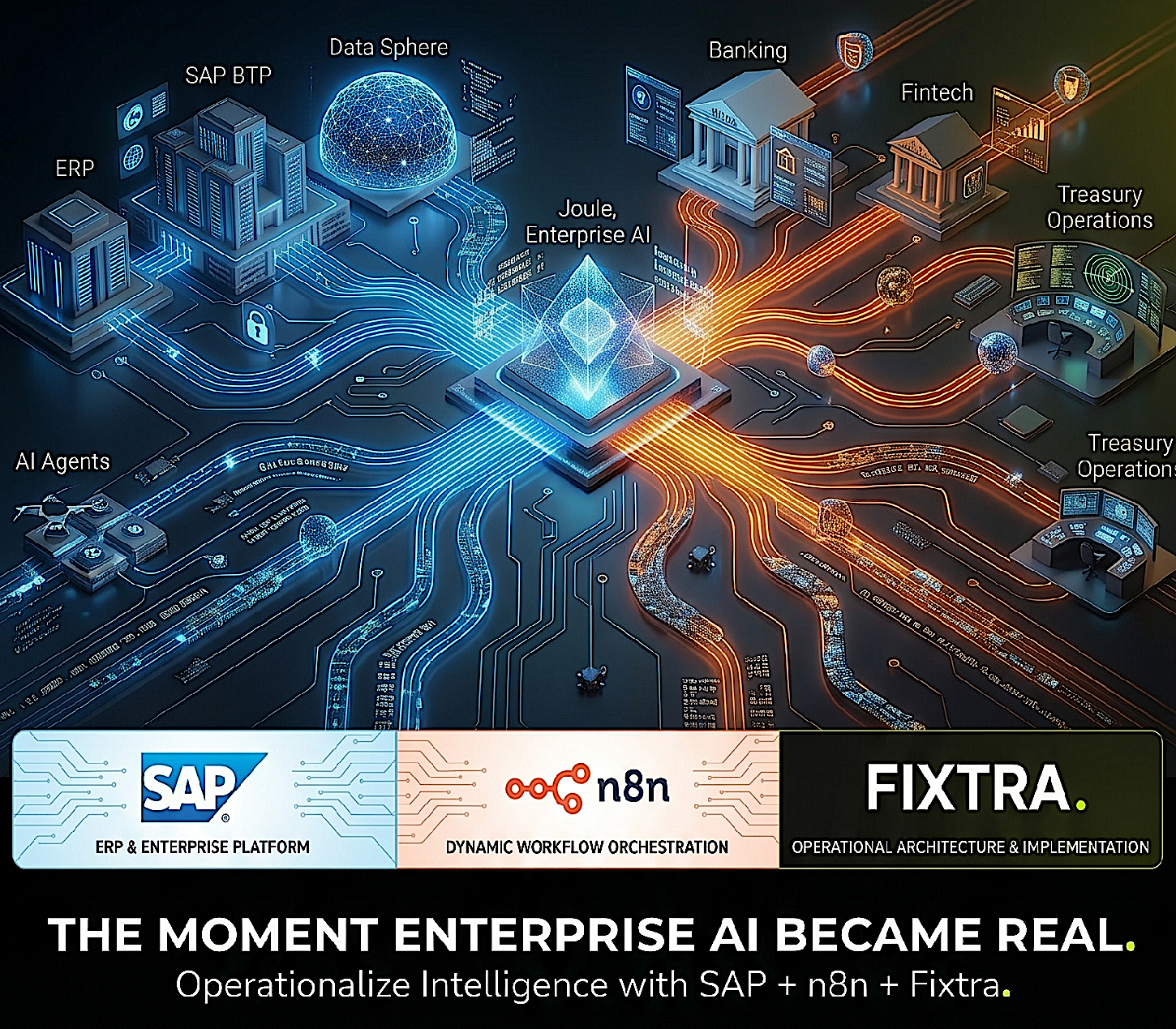
There are moments in technology when something subtle happens — and only later do people realize it changed everything.
The internet.
Cloud computing.
Mobile banking.
Generative AI.
And now, perhaps quietly but profoundly, another shift is beginning.
In May 2026, SAP announced a strategic investment in n8n alongside a long-term partnership to integrate n8n directly into SAP Joule, Joule Studio, and the broader SAP Business AI ecosystem.
At first glance, it may look like just another enterprise partnership.
It is not.
This move reveals something much bigger about where enterprise technology is heading — especially for banks, insurers, fintechs, and global organizations running complex operations.
Because for the first time, we are seeing the true convergence of:
- enterprise ERP,
- AI agents,
- workflow orchestration,
- automation,
- event-driven architecture,
- and real-time business intelligence
inside one operational ecosystem.
And honestly?
Most companies still underestimate how transformative this will become.
Enterprise Software Has Been Missing Something Critical
For years, companies invested billions into digital transformation.
They implemented ERP systems.
Built APIs.
Added analytics.
Connected cloud platforms.
Experimented with AI.
Yet somehow, many enterprises still operate like disconnected machines.
Data sits in one place.
Processes live somewhere else.
AI tools generate insights nobody operationalizes.
Humans manually bridge the gaps between systems every single day.
The result?
Slow operations.
Overloaded teams.
Complex integration landscapes.
And AI initiatives that often never move beyond presentations and proofs of concept.
What SAP and n8n are now building together addresses precisely this problem.
Not by adding “more AI.”
But by making AI operational.
SAP Is Reinventing Itself Around AI
For decades, SAP was primarily associated with ERP.
Today, SAP is becoming something fundamentally different.
With technologies like:
- SAP BTP,
- SAP Datasphere,
- SAP AI Foundation,
- SAP Build,
- SAP Event Mesh,
- and especially SAP Joule,
SAP is evolving into an intelligent enterprise platform designed around automation, context, and AI-driven operations.
And Joule sits at the center of that vision.
SAP describes Joule not as a chatbot, but as an enterprise AI copilot capable of understanding business context, orchestrating workflows, and helping users interact with systems through natural language.
But here is the important part many people miss:
AI alone is not enough.
An AI assistant that only answers questions changes very little.
The real revolution begins when AI can:
- trigger workflows,
- orchestrate systems,
- reason across processes,
- interact with APIs,
- coordinate tasks,
- and execute actions securely inside enterprise environments.
That is exactly why n8n matters.
Why n8n Changes the Equation
What makes n8n fascinating is that it sits perfectly between flexibility and enterprise orchestration.
It is visual enough for rapid workflow innovation.
Technical enough for developers.
Powerful enough for AI agents.
And open enough for real-world enterprise complexity.
This is not traditional automation.
This is orchestration.
The difference is enormous.
Traditional automation says:
“When X happens, do Y.”
Modern orchestration says:
“Understand context, make decisions, coordinate systems, involve AI, trigger workflows, adapt dynamically.”
That is a completely different world.
And it aligns almost perfectly with where SAP is going with Joule and SAP Business AI.
The Real Story Is Agentic AI
The phrase “agentic AI” is everywhere right now.
But very few organizations truly understand what it means in practice.
Agentic AI is not simply ChatGPT connected to a database.
It means AI systems capable of:
- planning,
- reasoning,
- orchestrating tasks,
- collaborating with systems,
- executing workflows,
- and adapting dynamically to business context.
SAP is investing heavily in this direction with Joule Agents and SAP AI Foundation.
n8n becomes the perfect orchestration layer underneath these capabilities.
Imagine what this looks like in a real enterprise.
A treasury anomaly appears inside SAP.
An AI agent detects unusual liquidity movement.
n8n orchestrates:
- data retrieval from SAP,
- external market analysis,
- risk scoring,
- compliance verification,
- approval workflows,
- notifications,
- and dashboard updates.
No swivel-chair operations.
No disconnected tools.
No manual coordination.
Just intelligent operational flow.
This is where enterprise AI stops being “interesting” and starts becoming transformational.
Banking Will Be One of the Biggest Winners
Few industries suffer more from operational complexity than banking.
Banks operate:
- hundreds of systems,
- thousands of workflows,
- massive compliance requirements,
- fragmented data landscapes,
- and constant pressure to reduce costs while improving customer experience.
At the same time, AI expectations are exploding.
Customers want instant decisions.
Real-time onboarding.
Hyper-personalized experiences.
Predictive services.
Proactive financial guidance.
Meanwhile regulators expect:
- auditability,
- governance,
- explainability,
- and security.
This is exactly why SAP’s architecture matters so much in financial services.
SAP’s ecosystem already emphasizes:
- event-driven banking,
- API-based composable architecture,
- AI-enabled operations,
- real-time data processing,
- and enterprise-grade governance.
n8n accelerates all of this.
Suddenly, banks can orchestrate:
- lending workflows,
- AML checks,
- fraud investigations,
- treasury operations,
- customer engagement journeys,
- payment orchestration,
- and AI-driven operational agents
far faster than before.
And importantly:
they can do this without constantly rebuilding core systems.
The Most Important Shift: AI Becomes Operational
For years, AI mostly lived in dashboards and experiments.
Interesting insights.
Predictive models.
Executive presentations.
But very little operational transformation.
That era is ending.
The combination of SAP + Joule + n8n creates something far more important:
AI that actually participates in enterprise operations.
Not replacing people.
But amplifying them.
Helping finance teams close faster.
Helping banks detect risk earlier.
Helping operations teams automate intelligently.
Helping organizations move faster without losing governance.
This is where the conversation becomes exciting.
Because the future enterprise will not operate through static software menus.
It will operate through:
- conversations,
- workflows,
- AI agents,
- event streams,
- and orchestration layers.
Why This Matters Beyond Technology
What makes this transformation fascinating is that it is not really about software.
It is about how organizations think.
Historically, companies optimized departments separately:
finance,
operations,
customer service,
compliance,
risk,
IT.
But AI orchestration changes the model entirely.
Processes become connected.
Intelligence becomes shared.
Decisions become contextual.
Operations become adaptive.
And perhaps for the first time, enterprise systems begin behaving less like databases and more like operational nervous systems.
That is why the SAP–n8n alliance matters.
It signals the transition from:
systems of record
to
systems of intelligence and action.
Fixtra’s Perspective: The Real Challenge Is Not AI — It’s Architecture
At Fixtra, we see many organizations rushing into AI with excitement but without operational foundations.
The reality is simple:
AI without orchestration creates chaos.
Automation without governance creates risk.
And enterprise transformation without architecture eventually collapses under complexity.
This is why the convergence of SAP, SAP BTP, Joule, and n8n is so powerful.
When implemented correctly, it creates:
- scalable automation,
- enterprise-grade governance,
- intelligent workflows,
- AI-driven operations,
- and real operational agility.
What excites us most is not simply automation itself.
It is the possibility of creating organizations that can continuously evolve.
Organizations where:
- AI agents collaborate with people,
- workflows adapt dynamically,
- systems communicate in real time,
- and innovation no longer takes years.
At Fixtra, this is exactly where we focus our expertise:
helping enterprises combine deep SAP knowledge, SAP BTP architecture, agentic AI, Joule capabilities, and advanced n8n orchestration into intelligent operational ecosystems that are secure, scalable, and truly enterprise-ready.
Because the future will not belong to organizations that merely “use AI.”
It will belong to organizations that operationalize intelligence across the entire enterprise.